The Autonomic Crash: Decoding Nervous System Breakdown When Consecutive Late Nights Destroy Your HRV
(A Garmin Venu 4 Case Study)
In the realm of human performance optimization under the principles of the Neuro-Calibration Protocol (NCP), we frequently discuss balancing the autonomic nervous system to achieve peak daytime efficiency. However, one critical factor that is often overlooked and becomes a major pitfall for high-performers is accumulated "Sleep Debt."
This article dives deep into a real-world case study, testing the biological limits through "consecutive late-night sleep deprivation," and tracking the physiological fallout via the Garmin Venu 4. We will explore exactly how this behavior damages vagal tone and suppresses Heart Rate Variability (HRV) at a systemic level.
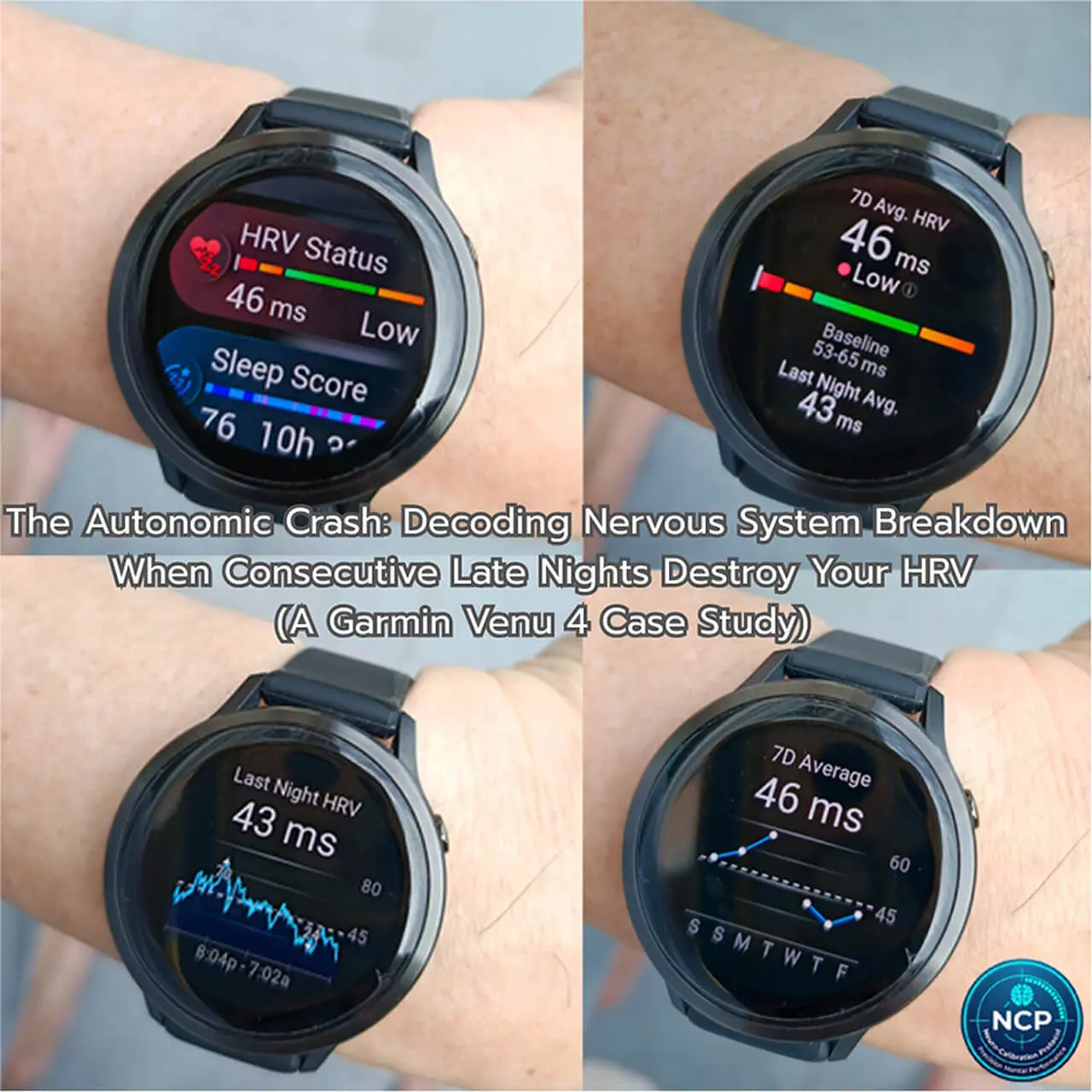
01. Phase 1: The First Warning Sign—When the Body Rejects Recovery
Staying up late or constantly shifting your sleep schedule pushes your body far beyond simple morning grogginess. It forces the sympathetic nervous system (the "fight-or-flight" mode) to remain activated overnight.
In the first image, a cellular-level distress signal is clearly broadcasted. The HRV Status has plummeted into the red zone, registering at a low 46 ms. Even though the overall Sleep Score might look like a passing grade at 76, this is merely a quantitative illusion. The true quality of deep nervous system recovery has failed. The body has lost its ability to apply the brakes and shift into the parasympathetic "rest and digest" state.
02. Phase 2: The "Cliff" Phenomenon of the Baseline (4-Week Trend)
To truly grasp the severity of this biological test, we need to zoom out and look at the macro trends over the past month.
The 4-week trailing graph illustrates a stark "Cliff Phenomenon." Normally, this physiological baseline is robust, maintaining a standard HRV range of 53-65 ms (the green band). This healthy baseline is a direct reflection of excellent systemic discipline.
However, the moment the consecutive late-night experiment began, the white trendline nose-dived out of the green zone. This is hard scientific evidence proving that no matter how optimized other areas of your lifestyle are, sleep is the foundational pillar. Once it collapses, the rest of the biological structure is primed to follow.
03. Phase 3: Deep Dive into the 7-Day Damage (The 7-Day Crash)
When we narrow our focus to the 7-day average (7D Avg.), the numbers expose the sheer magnitude of autonomic strain.
The 7-day average has dragged down to 46 ms, and even more alarming, the Last Night Avg. dropped to a critical 43 ms. This isn't normal daily fluctuation; this is a clear trend of Accumulated Fatigue. The body is burning through its reserve energy to keep vital systems running, causing the heart to beat with a rigid, inflexible rhythm (low HRV).
The 7-day dot graph maps the exact trajectory of this decline. From a stable position in the 60+ range, just a few late nights acted as the first falling domino, sending the curve crashing down to the 45 ms line. If left unchecked, this state leads directly to hormonal burnout and an increased risk of chronic systemic inflammation.
04. Phase 4: The Overnight Nervous System Battle (The Overnight Struggle)
The most crucial highlight of this physiological test is observing exactly what happens to the heart after closing your eyes.
The overnight HRV graph (spanning from 8:04 PM to 7:02 AM) shows severe structural distortion. Instead of a stable, gradually ascending curve as the body enters Deep Sleep, the graph exhibits violent swings, repeatedly crashing deep below the 45 ms threshold throughout the night.
Within the framework of the Neuro-Calibration Protocol, this is known as "Sympathetic Overdrive." Even though the physical body is asleep, the brain and nervous system remain highly alert. Cortisol refuses to follow its natural downward curve, actively blocking brain detoxification (Glymphatic Clearance) and muscle repair.
Conclusion & The Recovery Protocol
This data set from the Garmin Venu 4 reinforces a hard truth: You cannot negotiate with your own biology. Consistently sleeping late isn't just borrowing time from tomorrow; it is pillaging your own neurological resources at a staggering interest rate.
How do you recover when your HRV hits rock bottom?
If you are facing a cliff-drop graph like this, pulling your baseline back up requires an immediate, intentional nervous system "reset":
-
Vagal Down-Regulation: Strictly enforce a consistent sleep schedule. Block all blue light at least 90 minutes before bed to allow natural melatonin synthesis to occur uninterrupted.
-
Morning Autonomic Prime: Get outside immediately upon waking to absorb early morning sunlight. Pairing this light exposure with an active morning routine—whether it's an outdoor interval walk, running, or a targeted 8kg kettlebell session—effectively resets the circadian clock and signals biological safety to the nervous system.
-
Nutritional Fasting: Reduce the digestive burden during the evening. Shifting toward a One Meal A Day (OMAD) approach focused on clean, unseasoned whole foods—such as steamed mackerel, broccoli, carrots, or a nutrient-dense vegetable smoothie—allows the body to divert its energy away from digestion and entirely toward deep cellular repair during sleep.
Do not wait for your body to protest through total breakdown. Use the data on your wrist as a compass, and respect your biological rhythms... because elite performance begins in Deep Sleep.

About The Author
Dechathana Athithanphokin is an Autonomic Regulation Researcher and Performance Architect specializing in non-pharmacological neural calibration for high-stakes executives.